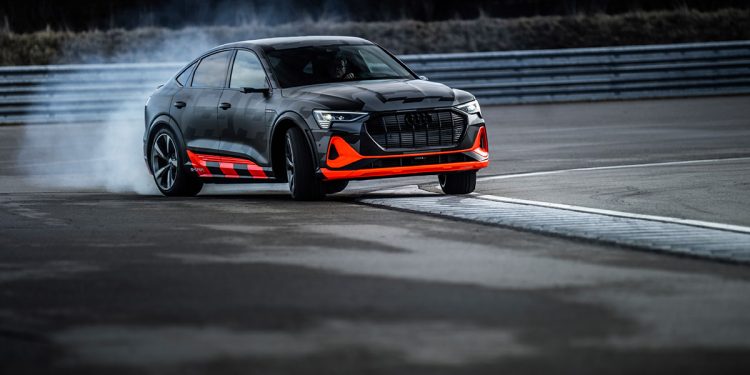
For four decades, Audi has been setting the pace with permanent quattro all-wheel drive and thus initiated a paradigm shift in powertrain technology in the automotive world and in motorsport. The brand is now using the knowledge it has accumulated in this area since 1980 for the next step. The electric quattro in the models of the e-tron range marks Audi’s next milestone achievement in the age of electric mobility. Enjoyable driving and efficiency are fused into a total package.
Audi combines quattro and e-tron into a powerful combination of high performance and notable economy. The company mass-produces an all-wheel drive system that is highly variable, dynamic and precise while making efficient use of the available energy.
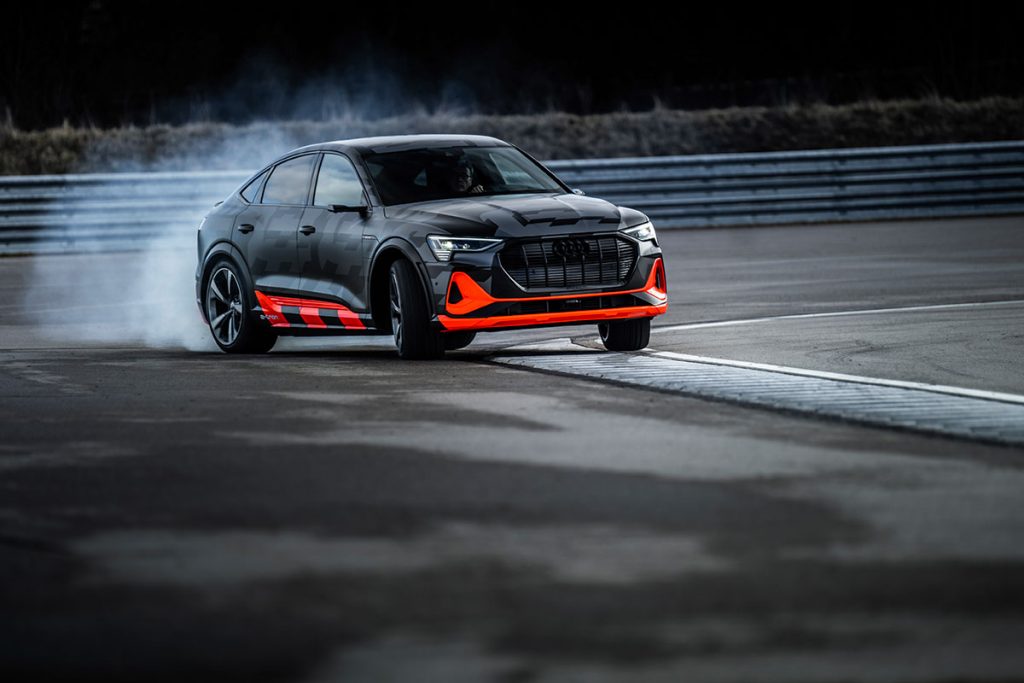
Why does Audi use electric all-wheel drive?
“For us, the electric quattro is the perfect combination of powerful performance and high efficiency,” says Michael Wein, Project Leader All-Wheel Drive Control Systems. “We combine the efficiency advantages of a driven axle with the traction and dynamic performance of an all- wheel drive system.” In the current e-tron model range, only the rear wheels propel the car in good traction conditions, while the motor for the front-wheel drive concurrently runs without being energized. Since the motor is an asynchronous type, there are no inherent electrical drag losses, so that this drive layout consumes a correspondingly low amount of energy. The front axle – within milliseconds and unnoticeably for the driver – is additionally activated only as needed – for instance, when there is a demand for high driving dynamics, high torque transfer, or in the case of a low coefficient of friction due to wetness, mud or snow.
What is so unique about electric quattro drive compared to competitors?
Audi is the first manufacturer to enable highly variable torque distribution in the e-tron S due to the drive topology featuring one motor at the front axle and two electric motors installed in a housing on the rear axle. In combination with sophisticated control and regulation, the electric quattro, due to its single-axle operation with variable, unnoticeably additional activation of the front axle, resolves the conflicting aims of dynamic performance and efficiency. Audi integrates functions such as electric torque vectoring on the rear axle, wheel-selective torque control due to a braking intervention with the mechanical differential, and high recuperation performance in an electric powertrain. Additionally, drivers can adjust the high variability of the system to their personal preferences by individual program selections.
When do e-tron and e-tron S models activate their electric all-wheel drive?
The electric all-wheel drive is active in situations of degrading grip on road surfaces with low coefficients of friction, in particularly dynamic driving conditions, when the driver demands high traction power, or when maximum recuperation is desired – in other words, the recovery of energy during braking and deceleration. If the driver decelerates the car to a level of 0.3 g, the electric motors act as generators, using the car’s kinetic energy and converting it into electrical energy which, in turn, charges the battery. This applies to more than 90 percent of all braking maneuvers in everyday driving situations. Only when stronger pedal pressure is applied, the system additionally and seamlessly activates the hydraulic wheel brakes. For instance, in a braking event at 100 km/h, the e-tron S can recover kinetic energy with output of up to 270 kW, compared to 250 kW in the Formula E electric racing series. If the driver demands full power while accelerating, the e-tron S models provide a total boost of 370 kW and torque of 973 Nm. Whether in drive or recuperation mode: interconnected control models always select the best torque distribution.
What opportunities does electric quattro open up compared to conventional all-wheel drive?
In the Audi e-tron models, one electric motor each drives the front and rear axle. By contrast, the e-tron S versions use one motor on the front axle and two on the rear axle. With electric torque vectoring – in other words, specific torque development left and right – the e-tron S provides quattro drive on the rear axle with even greater agility. The key advantage: Without a mechanical connection between the two electric motors on the rear axle, the functions of a controlled transverse differential lock and thus the functions of a sport differential have been achieved within a single system purely by means of software-based activation. Consequently, thanks to intelligent drive control, Audi has implemented active and fully variable torque distribution in transverse direction on the rear axle.
How did Audi achieve this high variability in the electric drive system?
Audi combines an electric powertrain architecture – a novelty in high-volume production – with sophisticated control units in which all the key software components and their network integration have been developed in-house. Compared to a mechanical all-wheel drive, this results in a fast-response drive system. For instance, latency in the case of electric torque vectoring – in other words, the time gap between the sensor measurement and active torque distribution – amounts to just 30 milliseconds. This is merely around a fourth of the response time of a mechanical system. In addition, electric drives provide clearly higher torque levels. Up to 220 Nm more torque can be allocated to the outside wheel in a cornering situation which, due to the transfer ratio, equates to as much as 2,100 Nm per wheel. This is how the drive system generates the desired yaw moment in cornering: The car correspondingly rotates around the vertical axis in the cornering direction and thus feels particularly agile. When the coefficient of friction on snow or ice is low, traction can be optimized with great precision as well: The respective friction coefficient of the driven wheels is measured and, due to the torque allocation, used in an ideal way, thus enhancing overall traction.
How is this precision control achieved?
Intelligent interlinking is the prerequisite for this software function. The drive control unit (DCU) distributes torque between the electric motors. The best possible energy conversion efficiency is decisive for optimizing efficiency. The integrating control unit of the Electronic Chassis Platform (ECP) uses sensor signals to monitor the car’s driving condition and calculates the ideal distribution of longitudinal and lateral torque. It integrates the vehicle dynamics control of the quattro, in other words, electric torque vectoring as well as wheel-selective torque control via the braking intervention on the front axle. At the dynamic limit, on the e-tron S, the wheel brake slightly decelerates the inside front wheel in cornering and on the e-tron, the front and rear wheels. Thus, via the effect of the mechanical axle differential, more torque is distributed to the outside and the car follows the steering command in the cornering direction with particular agility. The traction control system (TCR) acts at one-millisecond intervals. This is achieved because individual functional components of the electronic stability control (ESC) have been shifted into power electronics directly on the electric motors. The drive control unit coordinates the traction control system and the all-wheel controller, whereby the engineers gave priority to agile handling with a sporty basic layout.
Can the driver influence the characteristics of the electric quattro?
Drivers can adapt the electric quattro as desired via two controllers. The Audi drive select system, which is standard equipment for the e-tron models, offers seven profiles: comfort, auto, dynamic, efficiency, individual, allroad and offroad. Thus, among other things, the electric all-wheel drive as well as the suspension and other systems can be adapted to the road conditions and personal preferences. The electronic stability control (ESC) system contains four programs: Normal, Sport, Offroad and Off. In offroad conditions, it optimizes stability, traction and brake control, and activates the standard hill descent control system. In addition, drivers can select three levels of deceleration recuperation: In level 0, the car coasts, in level 1, the car slightly decelerates. In level 2, which has a deceleration range of up to 0.13 g and recuperates the largest amount of energy, drivers experience a strong one-pedal feel. In manual mode, the car retains the previously selected recuperation level.
Highlights
- Fundamentally new quattro drive architecture for electric models
- Optimized drive torque distribution in longitudinal and transverse direction
- Benefits: variable, dynamic, precise and powerful with maximum efficiency
You can add more to this story by commenting below.