JSW MG Motor India Achieves Milestone with 1,000 EV Community Chargers Installed Across India
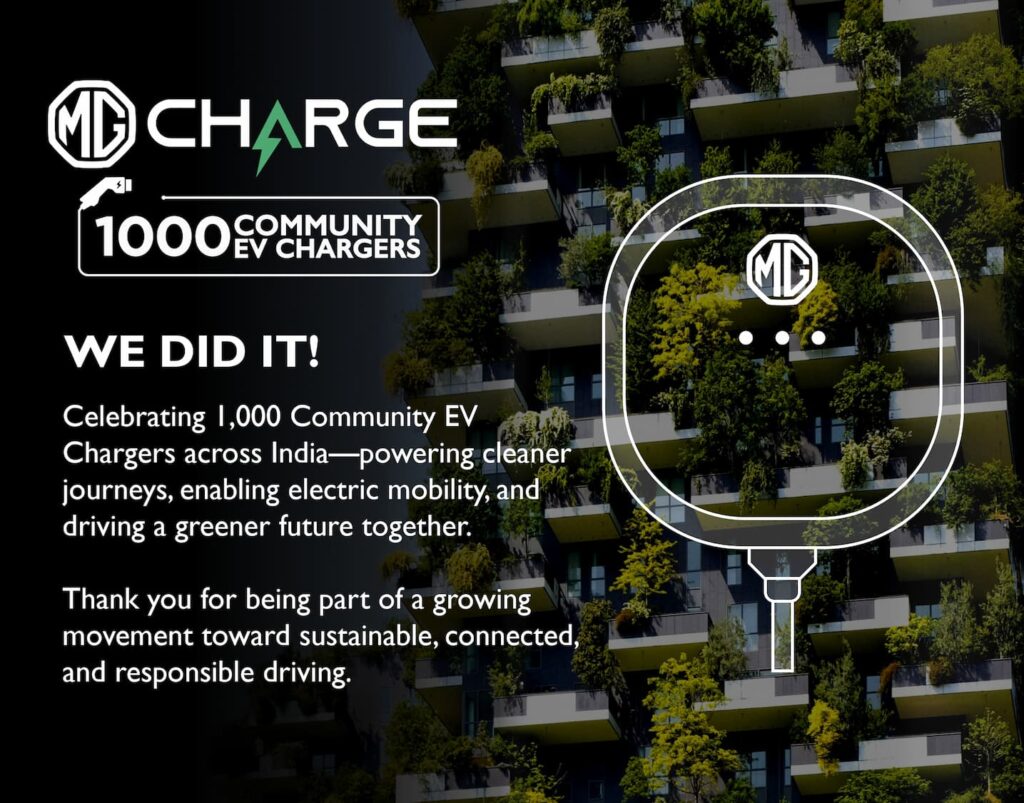
GURUGRAM, June 05, 2026 — On World Environment Day, JSW MG Motor India announced it has installed 1,000 community chargers under its MG Charge initiative. The installations span more than 470 sites across India, establishing the automobile manufacturer as the first original equipment manufacturer (OEM) to build EV community charging infrastructure at this volume in the country. The expansion targets critical infrastructure points, including residential societies, condominiums, schools and university campuses, hospitals, hotels, and industrial parks.
Scaling EV Infrastructure and Environmental Impact
The deployment of the MG Charge network directly aligns with growing vehicle adoption data. To date, MG electric vehicles (EVs) have cumulatively driven more than 290 crore green kilometres on Indian roads. This distance has resulted in a verifiable reduction of 4.17 lakh metric tons of carbon dioxide ($CO_2$) emissions.
By embedding 1,000 chargers within accessible community spaces, the manufacturer aims to resolve localized charging anxiety and support infrastructure readiness as consumer demand scales.
Strategic Product Expansion and Multi-Technology Roadmap
Formed as a joint venture in 2023 between SAIC Motor and the JSW Group, JSW MG Motor India operates with a mandate to develop a diverse portfolio of advanced, localized vehicles. The infrastructure milestone precedes an aggressive product pipeline planned for calendar year 2026 (CY2026).
The automaker has confirmed the upcoming launch of three new New Energy Vehicles (NEVs). This product expansion will include the introduction of plug-in hybrid technology, reflecting the company’s strategic stance that India’s transition to sustainable transportation requires a combination of multiple technological solutions rather than a singular framework.
Decarbonizing Manufacturing Operations at the Halol Facility
The commitment to decarbonization extends to the company’s production ecosystem. At its state-of-the-art manufacturing facility in Halol, Gujarat—which maintains an annual production capacity of over 100,000 vehicles—operations utilize more than 78% renewable energy. This renewable integration allows the plant to cover nearly 95% of its total power requirements, preventing more than 9,300 metric tons of carbon emissions.
The facility integrates Industry 4.0 solutions, utilizing digitization and the Internet of Things (IoT) to monitor energy efficiency and optimize manufacturing processes. Water consumption at the plant has decreased by 23% through deliberate process optimization and the systemic reuse of recycled water.
Key Sustainability Operations at the Halol Plant:
- Water Management: Operation as a Zero External Discharge Plant that utilizes 100% treated water, supported by 21 recharge wells.
- Waste Management: Certified with Zero Waste to Landfill – Gold Maturity; equipped with a bio-compost machine for canteen waste and a garden waste biogas plant for organic waste.
- Fuel and Emissions: Exclusive use of Piped Natural Gas (PNG) across all manufacturing processes to reduce reliance on heavier fossil fuels.
- Biodiversity: Established green coverage exceeding 11,000 trees, including a dedicated Miyawaki Forest containing 5,700 plants.
Key Takeaways
- First in Industry: JSW MG Motor India is the first OEM in India to deploy 1,000 community EV chargers.
- Measurable Carbon Reduction: Cumulative MG EV mileage has saved 4.17 lakh metric tons of $CO_2$.
- 2026 Product Pipeline: Three new NEVs are scheduled for launch in CY2026, introducing plug-in hybrid options to the market.
- Sustainable Production: The Halol plant sources 95% of its power from renewable setups and operates with zero external liquid discharge.
Frequently Asked Questions (FAQs)
How many community EV chargers has JSW MG Motor India installed?
JSW MG Motor India has installed 1,000 community chargers across more than 470 sites in India under its MG Charge initiative, making it the first OEM to accomplish this scale of community infrastructure in the country.
What is the environmental impact of MG’s electric vehicles in India?
MG electric vehicles have driven over 290 crore green kilometres on Indian roads, which has effectively prevented 4.17 lakh metric tons of $CO_2$ emissions from entering the atmosphere.
What are JSW MG Motor India’s vehicle launch plans for 2026?
The company is executing a product rollout for CY2026 that includes launching three new New Energy Vehicles (NEVs) and introducing plug-in hybrid technology to the Indian automotive market.
How green is the JSW MG Motor India manufacturing facility?
The Halol manufacturing facility meets nearly 95% of its total power needs using renewable energy sources, which accounts for over 78% of its overall energy mix and saves 9,300 metric tons of carbon emissions annually. It is also certified as a Zero Waste to Landfill (Gold Maturity) and Zero External Discharge plant.
You can add more to this story by commenting below,