The Dawn of a New Era for British Automobiles in India
The automotive landscape in India is on the verge of a historic transformation. For decades, Indian automotive enthusiasts and luxury buyers have faced exorbitant import taxes on completely built units (CBUs), artificially inflating the prices of global automotive icons. However, the recently signed India-UK Comprehensive Economic and Trade Agreement (CETA) is poised to rewrite the rules of luxury car ownership in the country.
The monumental nature of this agreement was highlighted by the Prime Minister of India, Narendra Modi, who announced the operational timeline of the CETA following discussions at the G7 Summit in Evian. On the social media platform X, the Prime Minister tweeted:
“A historic milestone for India-UK relations. Delighted to note that the India-UK Comprehensive Economic and Trade Agreement will enter into force on 15th July 2026. This agreement will significantly boost our bilateral trade and investment. It will also unlock numerous opportunities for Indian farmers, workers, MSMEs, startups and innovators and contribute meaningfully to the realisation of Viksit Bharat 2047. Both PM Starmer and I, who are in Evian for the G7 Summit, are naturally very happy with the significant momentum being added to our economic ties. @Keir_Starmer”
When the agreement officially enters into force on July 15, 2026, the implications for the Indian luxury automobile sector will be unprecedented. Through a mechanism of phased tariff reductions and strategic quotas, some of the most desirable vehicles on the planet are about to become significantly more accessible to the Indian consumer.
Understanding the Tariff Rate Quotas (TRQs) for Automobiles
To comprehend the sheer scale of the savings incoming, one must look at the fine print of the CETA regarding trade in goods. Historically, fully imported luxury vehicles faced basic customs duties ranging up to 110%, not including the additional GST and luxury cesses levied upon the total value.
Under the new CETA framework, the United Kingdom’s automobile sector will gain substantial market access to India through a Tariff Rate Quota (TRQ) system. For internal combustion engine (ICE) vehicles, the quota is allocated based on engine capacity. The agreement stipulates that the total annual quota will rise to 37,000 units within the first five years. For vehicles imported under this quota, the tariff duty will plummet from the existing rate of 110-60% down to an incredible 10%.
Even if a vehicle is imported outside of this 37,000-unit quota, buyers will still see relief. The out-of-quota duty reductions for ICE vehicles will drop the existing 110-66% duties down to 50-45%, depending on the vehicle’s engine capacity.
The “Made in UK” Catch: Why the Land Rover Defender Won’t Get Cheaper, but the Range Rover SV Will
While a 10% import duty sounds like an across-the-board win for all brands associated with the United Kingdom, there is a crucial technicality hidden within the agreement: the Rules of Origin.
The CETA establishes strict and clear rules for goods to qualify for preferential tax treatment. The agreement requires each party to establish that goods are either wholly obtained or entirely produced in the UK or India, using exclusively local materials, or meet specific product-specific rules of origin. In the automotive world, this essentially means the vehicle must be manufactured and assembled in the United Kingdom to reap the benefits of the 10% duty rate.
This introduces a fascinating dynamic for Jaguar Land Rover (JLR), an iconic British brand owned by India’s Tata Motors. The rugged and highly popular Land Rover Defender is widely perceived as a quintessential British vehicle. However, the Defender is primarily manufactured in JLR’s state-of-the-art facility in Nitra, Slovakia. Because it is assembled in the European Union and not the United Kingdom, the Defender fails to meet the CETA Rules of Origin. Consequently, it will not qualify for the 10% import duty and will likely remain at its current high price point.
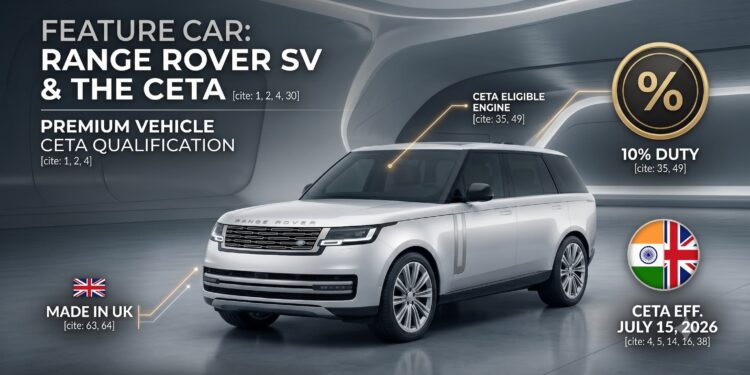
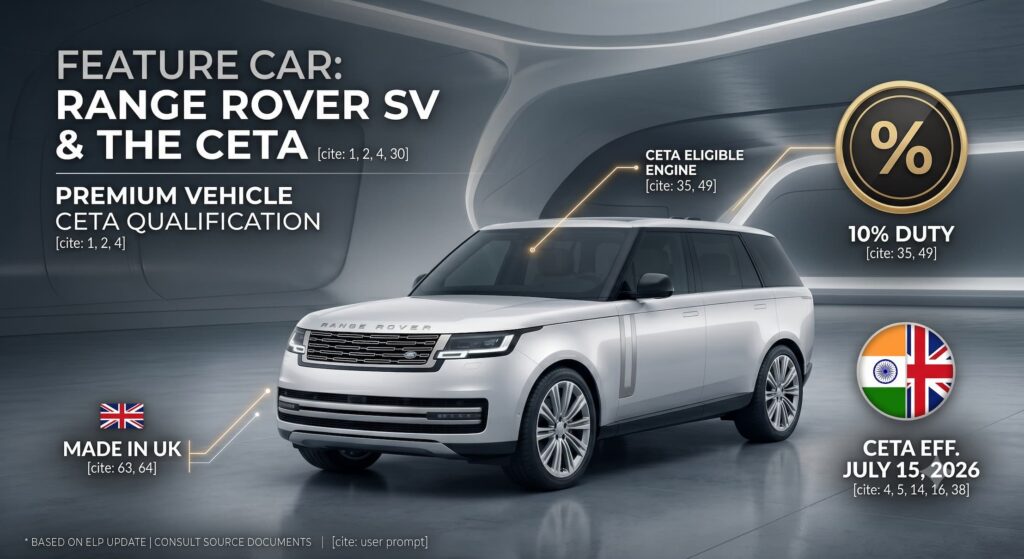
Conversely, the ultra-luxurious Range Rover SV is built at the Special Vehicle Operations (SVO) Technical Centre in Warwickshire, England, and the main manufacturing plant in Solihull, UK. Because it is completely built in the UK, the Range Rover SV perfectly satisfies the Rules of Origin criteria. As a result, buyers of the flagship Range Rover models manufactured on British soil will experience dramatic price reductions, creating an unusual scenario where the brand’s flagship luxury SUV might see a more significant proportional price drop than its utilitarian sibling.
The 10% Duty Club: How Much Money You Save on a McLaren 750S Post-Agreement
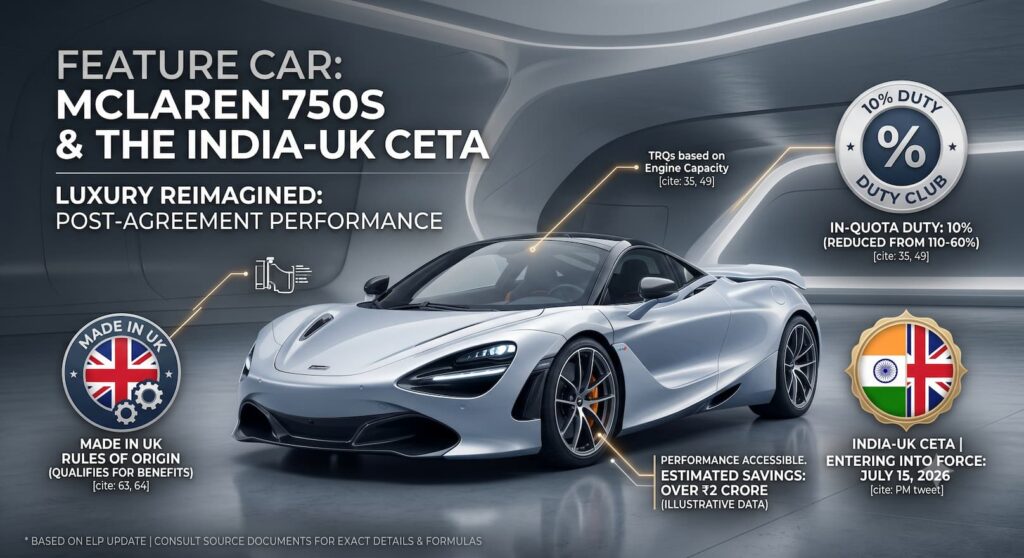
To truly grasp the financial magnitude of the CETA, let us examine the case of a British supercar: the McLaren 750S. Built in Woking, Surrey, the McLaren 750S is a masterpiece of engineering that currently carries an eye-watering ex-showroom price tag of approximately Rs 5.91 Crore in India.
The pricing of a CBU supercar in India is a compounding mathematical equation. First, the baseline cost of the car is calculated. Then, a massive basic customs duty (currently up to 100% or more for high-end sports cars) is applied. Finally, a 28% Goods and Services Tax (GST) plus a 22% compensation cess (totaling 50%) is applied not just to the base cost, but to the base cost plus the customs duty. It is a tax on a tax.
When the CETA drops the in-quota tariff duty from 110% to 10%, it breaks this compounding cycle. The customs duty shrinks to a fraction of its former self, which in turn drastically lowers the subtotal upon which the 50% GST and cess are calculated.
For a McLaren 750S, this systemic tax relief could theoretically erase over Rs 2 Crore from the final ex-showroom price. A car that once cost nearly Rs 6 Crore could potentially drop to the mid-to-high Rs 3 Crore range. This essentially unlocks a new tier of supercar ownership in India, effectively giving buyers the purchasing power they would have in international markets.
Estimated Price Impact on UK-Origin Cars in India
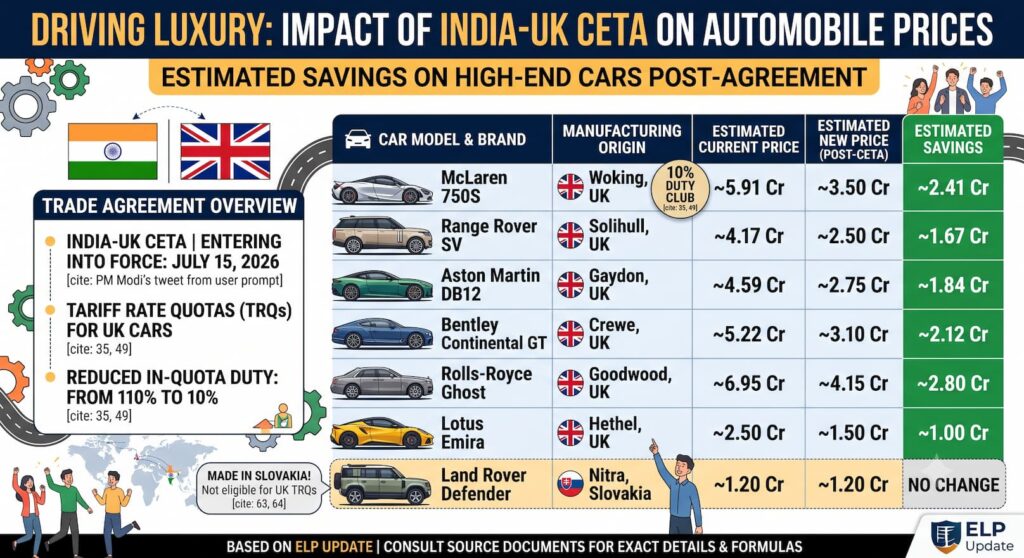
Below is a breakdown of highly sought-after UK-origin vehicles, projecting how the 10% in-quota customs duty could impact their pricing. (Note: These are estimates based on expected base price calculations; final retail prices will depend on manufacturer pricing strategies and exact CETA implementation formulas).
| Car Brand & Model | Manufacturing Origin | Current Estimated Ex-Showroom Price | Estimated New Price (Post-CETA) | Estimated Savings |
| McLaren 750S | Woking, UK | Rs 5.91 Crore | Rs 3.50 Crore | Rs 2.41 Crore |
| Range Rover SV | Solihull, UK | Rs 4.17 Crore | Rs 2.50 Crore | Rs 1.67 Crore |
| Aston Martin DB12 | Gaydon, UK | Rs 4.59 Crore | Rs 2.75 Crore | Rs 1.84 Crore |
| Bentley Continental GT | Crewe, UK | Rs 5.22 Crore | Rs 3.10 Crore | Rs 2.12 Crore |
| Rolls-Royce Ghost | Goodwood, UK | Rs 6.95 Crore | Rs 4.15 Crore | Rs 2.80 Crore |
| Lotus Emira | Hethel, UK | Rs 2.50 Crore | Rs 1.50 Crore | Rs 1.00 Crore |
| Land Rover Defender | Nitra, Slovakia | Rs 1.20 Crore | Rs 1.20 Crore | No Change (Non-UK Origin) |
What About Zero-Emission Vehicles?
While internal combustion engine supercars and SUVs will see immediate quota benefits, electric vehicles (EVs) have a slightly different timeline under the CETA.
For zero-emission vehicles (electric, hybrid, and hydrogen-powered), the TRQs are based on the Cost, Insurance, and Freight (CIF) price of the vehicle. The agreement explicitly states that no TRQs are provided for zero-emission vehicles priced below £40,000 CIF. Furthermore, no TRQs are provided at all for the first five years of the CETA.
However, playing the long game will pay off. After the initial five years, the in-quota duty on high-end British EVs will reduce from 110% to 10% by the end of the 10th year. The total annual quota for these zero-emission vehicles will eventually rise to 22,000 units by the 15th year. Therefore, while ICE vehicles get immediate gratification upon the agreement’s enforcement in 2026, the real EV price revolution will take a few extra years to materialize.
Conclusion
The India-UK CETA represents a watershed moment for the Indian automotive enthusiast. By slashing import duties from over 100% down to just 10% for up to 37,000 ICE vehicles annually, the treaty bridges the massive pricing gap between the Indian and global luxury car markets. As July 15, 2026, approaches, prospective buyers of brands like Aston Martin, Bentley, McLaren, and Rolls-Royce have millions of reasons to wait, as the dream of owning British automotive royalty is about to become significantly more attainable.
Frequently Asked Questions (FAQs)
When do the new car prices take effect in India?
According to Prime Minister Narendra Modi, the India-UK Comprehensive Economic and Trade Agreement (CETA) will officially enter into force on July 15, 2026. Import duty reductions will commence from this date.
Will all cars from British brands get cheaper?
No. The vehicle must be physically manufactured in the United Kingdom to qualify under the CETA’s Rules of Origin. Cars from British brands that are manufactured in other countries (like the Land Rover Defender built in Slovakia) will not be eligible for the 10% duty rate.
Is there a limit on how many cars can be imported at the 10% duty rate?
Yes. For Internal Combustion Engine (ICE) vehicles, there is a Tariff Rate Quota (TRQ) that caps out at 37,000 units annually for the first five years. Vehicles imported beyond this quota will still see a duty reduction, but to 50-45% rather than 10%.
Does this agreement apply to German or Italian luxury cars?
No, this specific trade agreement is strictly bilateral between India and the United Kingdom. It only applies to vehicles manufactured within the UK. German (Porsche, Mercedes, BMW) and Italian (Ferrari, Lamborghini) vehicles are not covered by this treaty.
You can add more to this story by commenting below.