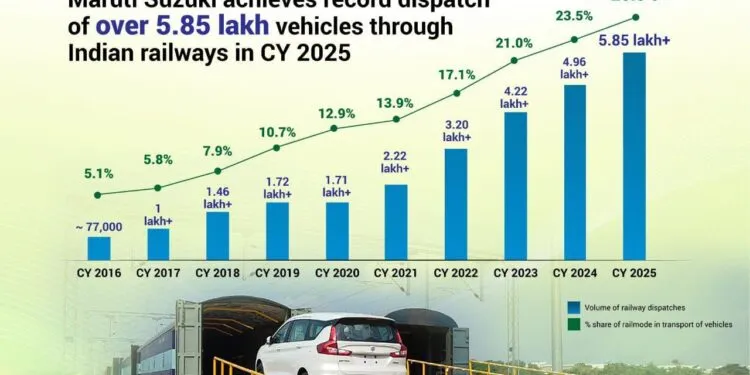
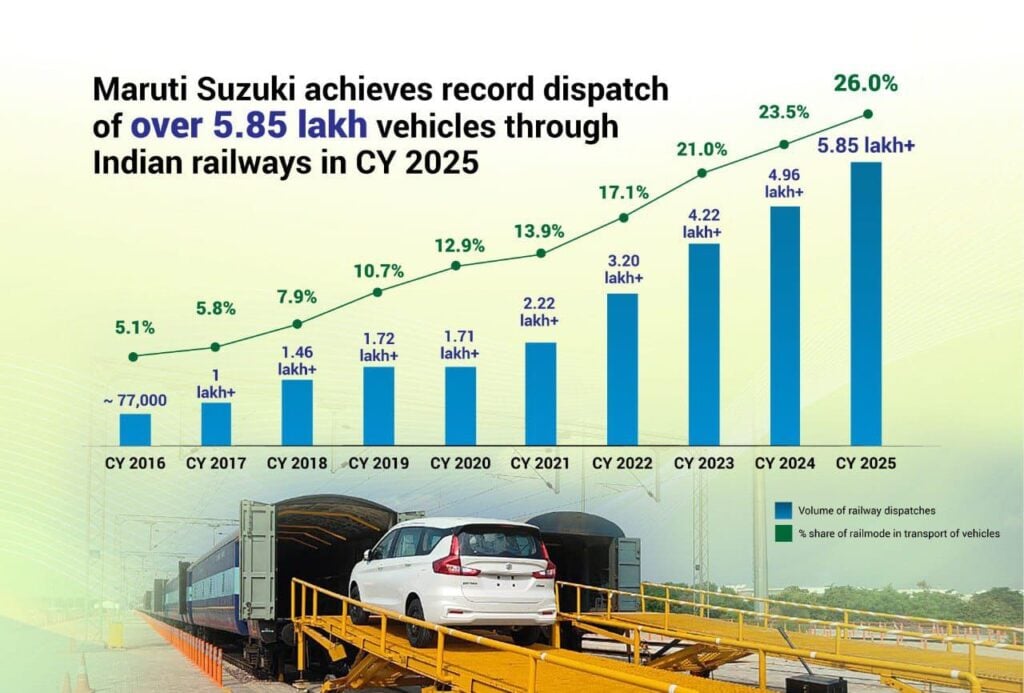
Maruti Suzuki India Limited has established a new benchmark in sustainable logistics by dispatching over 5.85 lakh vehicles via Indian Railways in the calendar year 2025. This achievement represents an 18% growth compared to CY 2024.
By leveraging the rail network, the company has significantly enhanced its “Circular Mobility” approach, which focuses on reducing the carbon footprint across the entire vehicle lifecycle.
Environmental and Economic Impact
The shift toward rail-based logistics has yielded substantial environmental benefits in 2025:
- Carbon Emissions: Avoided 87,904 metric tonnes of CO2 (carbon dioxide equivalent) emissions.
- Fuel Conservation: Saved more than 687 lakh (68.7 million) litres of fuel.
- National Impact: Contributed to reducing the country’s oil imports and easing road congestion.
A Decade of Exponential Growth
Over the last ten years, Maruti Suzuki’s reliance on rail transport has grown more than fivefold in terms of percentage share.
| Feature | CY 2016 | CY 2025 |
| Total Rail Dispatch Volume | ~77,000 units | 5.85 lakh+ units |
| Share in Outbound Logistics | 5.1% | ~26% |
| Growth Multiple | – | Over 7.5 times |
Major Milestones in 2025
The record-breaking performance in 2025 was driven by two landmark events highlighted by Mr. Hisashi Takeuchi, MD & CEO of Maruti Suzuki India Limited:
1. India’s Largest In-Plant Railway Siding
In June 2025, the company inaugurated India’s largest automobile in-plant railway siding at the Manesar facility. This facility alone has a dispatch capacity of 450,000 vehicles per annum. Together with the Gujarat facility siding, in-plant rail operations accounted for 53% of the company’s total rail dispatches in 2025.
2. Historic Connectivity to Kashmir
In October 2025, Maruti Suzuki became the first automobile manufacturer to dispatch vehicles to the Kashmir Valley via the world’s highest railway arch bridge over the Chenab River. The first batch of vehicles moved by rail to the Anantnag terminal.
Future Roadmap: Vision 2030-31
Maruti Suzuki aims to continue its aggressive expansion of green logistics. The company’s mid-term goal is to increase rail-based vehicle dispatches to 35% by FY 2030-31. This initiative is part of a broader commitment to support India’s net-zero ambition by 2070.
Currently, the company utilizes over 45 flexi deck rakes, with each rake capable of carrying approximately 260 vehicles per trip. Since obtaining the AFTO (Automobile-Freight-Train-Operator) license in 2013, the company has transported over 28 lakh vehicles via rail.
Frequently Asked Questions (FAQs)
How many vehicles did Maruti Suzuki dispatch via rail in 2025? Maruti Suzuki dispatched over 5.85 lakh vehicles through Indian Railways in CY 2025.
What is the environmental benefit of Maruti Suzuki’s rail dispatches? In 2025, rail dispatches helped avoid 87,904 metric tonnes of CO2 emissions and saved over 687 lakh litres of fuel.
Which Maruti Suzuki facilities have in-plant railway sidings? Maruti Suzuki has in-plant railway sidings at its Gujarat and Manesar facilities. The Manesar siding, inaugurated in June 2025, is the largest of its kind in India.
What is the company’s target for rail dispatches by 2030? The company aims to increase its share of rail-based vehicle dispatches to 35% by the financial year 2030-31.
When did Maruti Suzuki first reach 2 million cumulative rail dispatches? The company reached the milestone of 2 million cumulative vehicles dispatched through railways in June 2024.
You can add more to this story by commenting below.