Hyundai’s Aggressive Growth Plan: 2 New Nameplates, Mass Market EV, and Mega Expansion
Hyundai Motor India is preparing a massive offensive for the upcoming financial year, officially confirming the introduction of two completely new SUV nameplates. Revealed during the brand’s FY2026-27 outlook presentation, the automaker is setting the stage for a dual-powered strategy: an all-new internal combustion engine (ICE) SUV and a mass-market electric vehicle (E-SUV).
This major product offensive is backed by a monumental capital expenditure of approximately Rs. 7,500 Crore (Rs. 75,000 Million) and a significant manufacturing scale-up, particularly at the newly acquired Pune facility. Here is a detailed breakdown of what the Korean automaker has in store for the Indian market.
The Two New Nameplates: Expanding the SUV Dominance
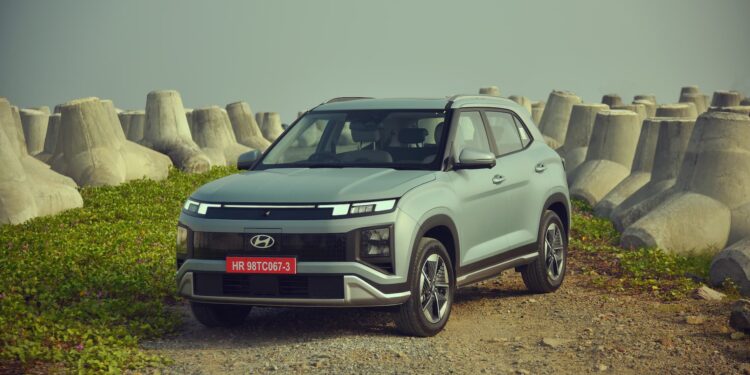
Hyundai is already a formidable player in the Indian SUV segment with stalwarts like the Creta and Venue. However, to capture an even larger market share and tap into evolving consumer demands, the brand is rolling out two brand-new models.
The Mass-Market Electric SUV (E-SUV)
The electric vehicle segment in India is heating up, and Hyundai is preparing to enter the mass-market EV space with a localized, dedicated electric SUV. Unlike the premium Ioniq 5, this upcoming E-SUV is designed for volume sales and everyday practicality.
- Segment Positioning: Expected to compete directly with the Tata Nexon EV and Mahindra XUV400.
- Focus Areas: High localization to keep pricing aggressive, robust urban usability, and competitive range figures tailored for Indian driving conditions.
- Significance: This marks Hyundai’s earnest attempt to democratize electric mobility in India, acting as a critical volume driver for their alternative fuel portfolio.
The All-New ICE SUV
While EVs are the future, internal combustion engines remain the present. To fortify its ICE lineup, Hyundai is bringing a new compact or mid-size crossover.
- Segment Positioning: Speculated to target the booming sub-compact crossover space, rivaling the likes of the Maruti Suzuki Fronx and upcoming localized compact SUVs.
- Powertrain: Expected to feature highly refined petrol engines, with potential CNG options to cater to cost-conscious buyers.
- Features: Premium cabin tech, advanced connected features, and top-tier safety equipment are anticipated to be standard, staying true to Hyundai’s brand ethos.
Unlocking Manufacturing Might: Pune and Chennai Plants
To support this aggressive product roadmap, Hyundai is drastically increasing its production capabilities. A significant portion of the Rs. 7,500 Crore capex is earmarked for upgrading and expanding its manufacturing footprint, primarily focusing on the Pune plant (formerly owned by General Motors).
Production Capacity Roadmap
Hyundai’s current installed capacity stands at 994,000 units annually across its two plants. Through a phased expansion, the automaker aims to reach an impressive 1,144,000 units.
| Manufacturing Facility | Existing Capacity | Phase II Target | Post Phase II Target |
| Chennai Plant | 824,000 units | 824,000 units | 824,000 units |
| Pune Plant | 170,000 units | 250,000 units | 320,000 units |
| Total Annual Capacity | 994,000 units | 1,074,000 units | 1,144,000 units |
This phased expansion allows Hyundai to comfortably produce the new E-SUV and ICE SUV without cannibalizing the production lines of their existing high-demand models like the Creta and Exter.
Financial Outlook and Mega Investment (Capex)
The financial roadmap laid out by Hyundai for FY2026-27 is highly optimistic, relying heavily on the success of these two new nameplates and the expanded manufacturing base.
- Capital Expenditure: Hyundai is deploying roughly Rs. 75,000 Million (Rs. 7,500 Crore). Nearly half of this is directed toward product-related investments for the new SUVs, while the rest goes into manufacturing upgrades.
- Growth Projections: The automaker has guided an 8% to 10% growth in domestic sales volumes. Interestingly, despite global geopolitical uncertainties, Hyundai expects export volumes to match this 8% to 10% growth rate, utilizing India as a vital export hub.
- Profitability: The company is targeting an EBITDA margin between 11% and 14%, indicating a strategic balance between aggressive market penetration and sustained profitability.
What This Means for the Auto Industry
Hyundai’s dual-pronged approach—introducing a volume-driver EV while expanding its ICE portfolio—shows a pragmatic reading of the Indian market. They are not abandoning the highly profitable petrol/CNG segments, yet they are fully committing to the EV transition with localized manufacturing.
By scaling the Pune plant to an eventual 320,000 units, Hyundai is ensuring that supply chain constraints will not bottleneck their growth in the latter half of the decade. This aggressive posturing will undoubtedly force competitors to accelerate their own product timelines, leading to better pricing and technological advancements for the end consumer.
Frequently Asked Questions (FAQs)
What new cars is Hyundai launching in India?
Hyundai has confirmed the launch of two entirely new SUV nameplates for FY2026-27. This includes one mass-market Electric SUV (E-SUV) and one all-new internal combustion engine (ICE) SUV.
Where will the new Hyundai SUVs be manufactured?
The new SUVs will heavily rely on the capacity expansion at Hyundai’s manufacturing plants. While the Chennai plant operates at a massive 824,000 unit capacity, the newly acquired Pune plant is scaling up to 320,000 units to support future growth.
What is the expected capacity of Hyundai’s Pune plant?
Currently at 170,000 units, the Pune plant will scale to 250,000 units in Phase II, and eventually reach 320,000 units Post Phase II.
How much is Hyundai investing in India for FY2026-27?
Hyundai has outlined a capital expenditure (capex) of approximately Rs. 7,500 Crore (Rs. 75K million) for product development and manufacturing expansion in the upcoming financial year.
What are Hyundai’s growth targets for FY2026-27?
The company has guided an 8% to 10% growth in both domestic sales and export volumes, alongside an EBITDA margin target of 11% to 14%.
You can add more to this story by commenting below.